
Questions and answers from the first full-scale biosolids gasification facility in the U.S.
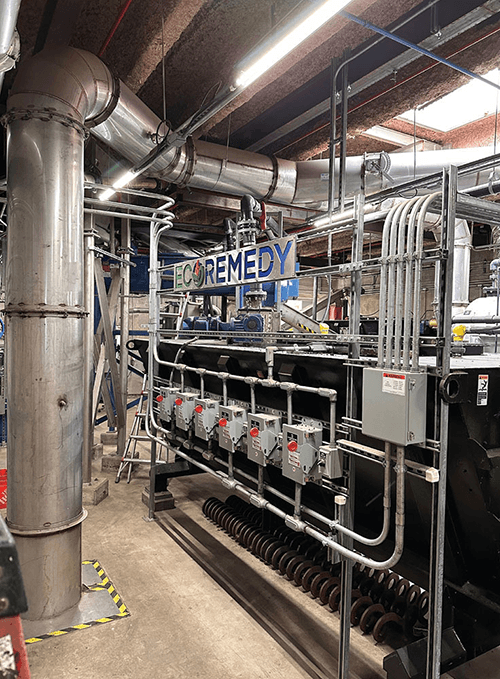 For decades, land-applying municipal biosolids — enriching agricultural soils using stabilized, nutrient-rich solids generated during wastewater treatment — has represented one of the water sector’s most commonsense avenues for circularity and beneficial reuse.
Its practice has become exceedingly common. As recently as 2022, the U.S. Environmental Protection Agency (EPA) estimated that approximately 56% of municipal biosolids generated in the U.S. return to the land as soil amendments in agricultural, landscaping, or gardening applications. Despite the method’s clear agronomic and economic benefits, growing concerns around chemical contaminants like per- and polyfluoroalkyl substances (PFAS) are rapidly reshaping the biosolids-management conversation.
The persistence of PFAS in treated biosolids presents a significant barrier to their beneficial reuse. Once land-applied, these compounds can run off to surface water and leach groundwater, contributing to long-term environmental contamination. Moreover, uncertainties surrounding PFAS behavior in soil, particularly in terms of plant uptake and animal exposure, further complicate risk assessments. These uncertainties have eroded public confidence and led to reduced farmer participation in biosolids land-application programs, increasing operational costs for utilities who are increasingly moving toward landfilling as the safer and more cost-effective option.
At the same time, regulatory pressure continues to build through federal research initiatives and state-level policy actions. A 2025 EPA draft risk assessment suggests that concentrations of common PFAS compounds as low as 1 part per billion (ppb) in land-applied biosolids may pose health risks, hinting at the possibility of enforceable future limits. In the interim, several U.S. states have adopted their own PFAS-mitigation policies that include enhanced industrial pretreatment mandates or outright bans on land application.
Given the growing regulatory momentum and environmental concerns, there is an urgent need for advanced treatment solutions capable of effectively destroying PFAS in biosolids. Gasification may represent a solution. But first, the water sector must navigate its remaining unknowns about safety, efficacy, and sustainability.
Read the full article by Mohammad Abu-Orf, Kamruzzaman Khan, and Micah Blate in the Digital WE&T Magazine.
FEATURED IN